




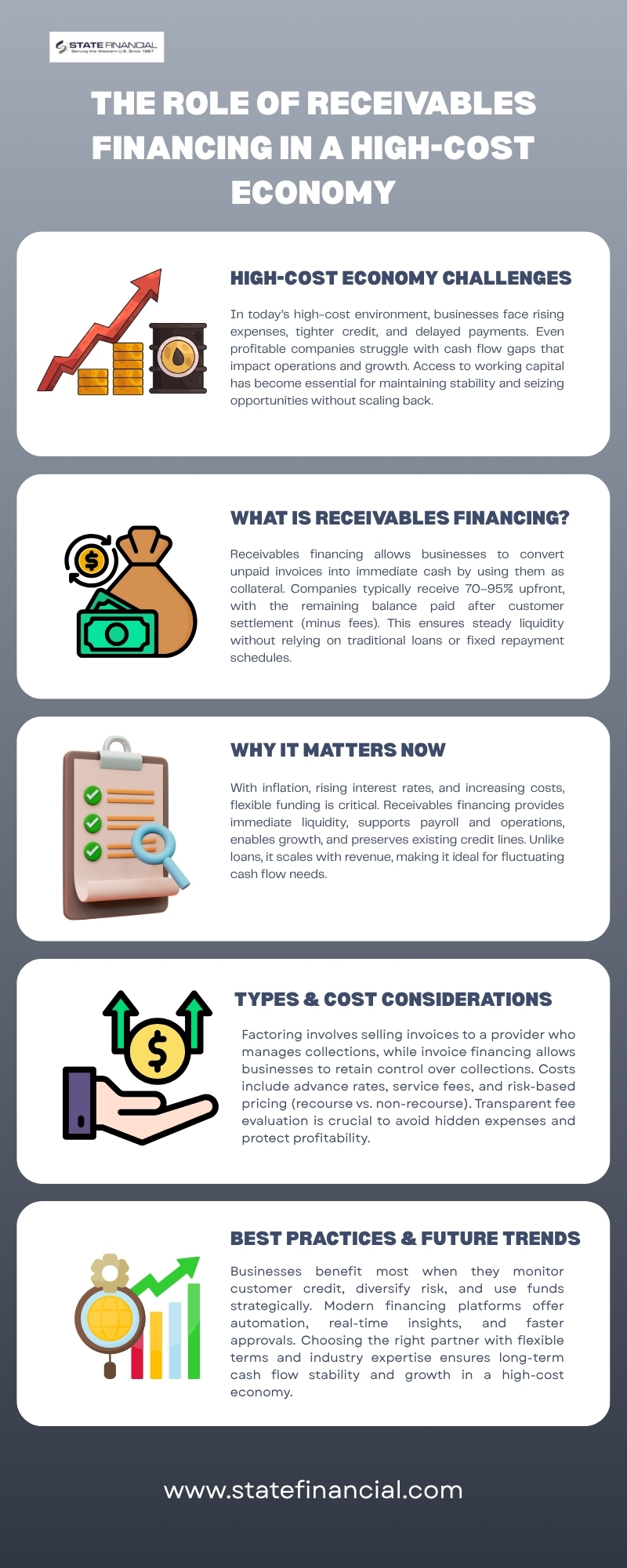
In today’s high-cost economic environment, businesses face rising operational expenses, tightening credit, and increasingly delayed customer payments. Even profitable companies may experience cash flow pressures that make it difficult to sustain operations, invest in growth, or capitalize on new opportunities. In such conditions, access to working capital is crucial, and receivables financing has become an indispensable tool for businesses aiming to maintain financial stability.
Receivables financing allows companies to convert outstanding invoices into immediate cash. This not only ensures liquidity for daily operations but also supports strategic growth initiatives without taking on traditional debt. For firms navigating economic headwinds, this type of financing can be the difference between seizing opportunities and being forced to scale back operations.
Understanding Receivables Financing
Receivables financing is a financial solution in which a business uses its unpaid invoices as collateral to access cash. Unlike conventional loans that rely on a borrower’s creditworthiness or balance sheet strength, this method focuses primarily on the quality of the invoices and the reliability of the paying customers. This makes it especially suitable for small and medium-sized businesses or rapidly expanding companies that may not qualify for traditional credit.
By advancing funds against invoices, companies can immediately pay for payroll, supplier obligations, or other operating expenses. Typically, businesses receive an advance of 70–95% of the invoice value upfront, with the remaining balance remitted minus fees once the customer pays. This approach ensures that cash flow aligns more closely with business activity rather than rigid loan schedules.
Why Receivables Financing Matters in a High-Cost Economy
Economic pressures such as rising interest rates, inflation, and higher labor and material costs have intensified the need for flexible financing options. Fixed-term loans, which often require consistent repayment regardless of cash inflows, can strain a business’s resources when costs fluctuate. Receivables financing, by contrast, scales with the company’s revenue, making it an ideal solution for businesses facing variable cash needs.
The benefits of receivables financing include:
- Immediate liquidity: Businesses gain fast access to cash tied up in invoices, reducing reliance on expensive short-term loans or lines of credit.
- Operational flexibility: Companies can continue to pay suppliers, manage payroll, and maintain operations without disruption.
- Growth support: Firms can take on larger orders or expand into new markets without being restricted by cash constraints.
- Preserved credit options: Since the financing is asset-backed, it often does not interfere with existing credit facilities or lines of credit.
The Role of Receivables Financing Companies
Receivables financing companies play a central role in enabling businesses to leverage unpaid invoices. These companies provide the infrastructure, underwriting, and operational support necessary for businesses to access funds quickly. Their expertise in evaluating invoice quality and assessing customer credit risk ensures that businesses receive reliable funding with minimal delay.
By partnering with a reputable receivables financing company, businesses can focus on growth and operations rather than managing complex cash flow challenges. These companies also offer flexibility in funding arrangements, allowing firms to scale financing up or down based on seasonal demands and sales fluctuations.
Factoring vs. Invoice Financing: Choosing the Right Option
While both factoring and invoice financing fall under the umbrella of receivables-based solutions, they differ in structure and operational implications.
A factoring accounts receivable company purchases invoices outright from a business and assumes responsibility for collecting payment from customers. This model provides the dual advantage of immediate cash and reduced administrative burden, as the factor manages collections on behalf of the company. Factoring is particularly beneficial for businesses that prefer to outsource collections and minimize internal accounting workloads.
Invoice financing, on the other hand, allows the business to borrow against its outstanding invoices while retaining responsibility for collecting payments. This approach helps maintain customer relationships and control over the sales ledger but requires the company to manage collections internally. Each option carries its own costs and operational considerations, making it important to select the structure that aligns with business goals and cash flow needs.
Understanding Costs and Fees
In a high-cost economy, evaluating the true cost of financing is essential. Fees for receivables financing typically include:
- Advance rate: The portion of an invoice’s total value that is disbursed to the business immediately.
- Discount or factor fee: A percentage of the invoice value charged for the service.
- Credit risk allocation: Non-recourse factoring fees are generally higher because the factor assumes the risk of non-payment, while recourse arrangements transfer this risk to the business.
Companies should carefully examine all fees, including potential hidden costs such as setup charges or administrative expenses, to understand the effective annualized cost. Transparent fee structures help businesses make informed decisions and avoid surprises that can impact profitability.
Who Benefits Most from Receivables Financing?
Receivables financing is particularly advantageous for businesses with a substantial volume of B2B transactions and invoice-based revenue. Common industries that benefit include manufacturing, distribution, staffing, construction, healthcare services, and transportation.
Growing companies find receivables financing especially valuable because it aligns funding with sales growth. Seasonal businesses also benefit, as financing availability automatically fluctuates with invoice volume, providing liquidity during peak demand and easing pressure during slower months.

Risk Management and Best Practices
While receivables financing offers significant advantages, prudent management is critical to ensuring sustainable benefits. Best practices include:
- Monitoring customer creditworthiness: Understanding who owes money and their likelihood of payment helps prevent funding gaps.
- Avoiding concentration risk: Diversifying the customer base reduces vulnerability to late payments from any single client.
- Strategic use of funds: Advances should support core operations or growth, not cover chronic operational shortfalls.
- Comparing recourse vs. non-recourse options: Businesses should understand who assumes risk for unpaid invoices and how this affects fees and obligations.
By pairing receivables financing with strong accounting practices, companies can optimize cash flow without over-reliance on external funding.
Technology and the New Wave of Financing Providers
Technological advancements have transformed receivables financing. Modern platforms integrate with accounting software, automate invoice submission, and provide real-time reporting. Advanced analytics help providers assess credit risk more accurately and make faster funding decisions.
This combination of speed, transparency, and automation is particularly valuable in a high-cost economy, where timely access to capital can determine whether a business can seize an opportunity or simply survive.
The Growing Role of AR Factoring Companies
For businesses seeking a hands-off approach to collections, ar factoring companies offer an effective solution. These companies purchase invoices, advance cash, and manage collections, enabling companies to focus on growth rather than administrative tasks.
As economic pressures persist, more small and mid-sized businesses are turning to AR factoring to stabilize cash flow, reduce operational burden, and improve financial predictability.
Choosing the Right Financing Partner
Selecting the right receivables financing partner is critical. Businesses should look for providers with:
- Industry experience and understanding of specific business sectors
- Transparent pricing and clear contract terms
- Flexible funding arrangements to match sales cycles
- A proven history of dependable service and prompt, attentive customer support.
Comparing multiple providers, analyzing sample fee structures, and reviewing contract terms thoroughly can help businesses select a partner that meets both operational and financial needs.
Conclusion
In a high-cost economy, liquidity is more than a convenience it is a strategic necessity. Receivables financing provides businesses with a reliable way to convert unpaid invoices into working capital, ensuring operational continuity, supporting growth, and mitigating the challenges of delayed customer payments.
By understanding the nuances of factoring, invoice financing, and the role of financing companies, businesses can make informed decisions that enhance cash flow, reduce risk, and improve financial resilience. Whether partnering with a receivables financing company, a factoring accounts receivable company, or AR factoring companies, businesses now have powerful tools to manage cash flow efficiently and navigate the pressures of a high-cost economic environment.