




Cash flow stability is essential for every business. Whether you are a new entrepreneur or a seasoned business owner, waiting weeks or months for customers to pay invoices can interrupt daily operations and restrict growth. Many companies face the same challenge. They deliver products or services on time, issue invoices promptly, but still wait far too long to receive payment. This gap between issuing an invoice and collecting the funds affects payroll, inventory purchases, marketing efforts, and expansion opportunities.
To bridge this gap, businesses often turn to invoice financing or invoice factoring. These solutions may appear similar at first glance because both allow you to convert outstanding invoices into immediate cash. However, the way they function, the responsibilities they include, and the costs associated with them are very different. Understanding these differences is the key to selecting the right financial solution for your business model.
This comprehensive guide explains how invoice financing works, how invoice factoring operates, what separates the two, the benefits of each, and how to determine which option fits your goals. The article also includes market insights, real examples, and key decision criteria to help you make a confident choice.
What Invoice Financing Means for Your Business
Invoice financing is a funding structure where a lender advances a percentage of the value of your unpaid invoices. You continue to own the invoices, and your business remains responsible for customer communication, billing, and collection. The lender simply uses your unpaid invoices as collateral while providing you with early access to funds.
When you apply for invoice financing, the lender primarily evaluates the credit quality of your customers because your customers are responsible for paying the invoices. If your customers have strong payment histories, your approval chances are high even if your business is new or lacks a strong credit profile. Advance rates typically range from 70 percent to 90 percent of the invoice value.
Once the customer pays the invoice, the lender releases the remaining balance after subtracting interest charges. The cost structure functions similarly to short term credit because the longer the invoice takes to be paid, the higher the interest expense.
One reason businesses choose invoice financing is privacy. Customers are usually unaware that the invoice has been financed. You maintain complete control over the customer relationship, which is extremely important for companies that value confidentiality or want to avoid giving the impression that they rely on external funding.
What Invoice Factoring Involves
Invoice factoring is a more hands on funding method because it involves selling your unpaid invoices to a factoring company that then collects the payment from your customers. After purchasing the invoices, the factoring company pays you an advance and holds the remaining reserve amount until the customer pays in full. Once the customer submits the payment, the factor releases the remaining funds minus the factoring fee.
Many businesses choose to work with an account factoring company when they want support not only with funding but also with accounts receivable management. The factoring company may handle customer reminders, credit analysis, and payment follow ups, which reduces the administrative burden on your internal team.
Factoring comes in two main forms. With recourse factoring, your business is responsible if the customer fails to pay. With non recourse factoring, the factoring company assumes the risk of non payment, although the cost is typically higher. Companies with clients that pay slowly or clients with unpredictable payment habits often find factoring especially useful.

The Core Differences Between Invoice Financing and Factoring
Even though both options help businesses prevent cash flow gaps, understanding the operational differences is essential. The following distinctions play a major role in deciding which method fits your business needs.
Ownership of Invoices
Invoice financing allows you to keep the invoice on your books. Factoring requires you to sell the invoice to the factor, which means the factor legally owns the receivable.
Customer Notification
With invoice financing, customers do not need to know about the arrangement. With factoring, customers are usually informed because they must send payment to the factoring company.
Administrative Responsibilities
Invoice financing leaves all collection tasks in your hands. Factoring shifts collections to the factoring company, which can save time and improve efficiency.
Cost Structure
Invoice financing uses interest based pricing. Factoring uses a fee model that may increase based on how long the invoice remains unpaid.
Privacy Levels
If confidentiality matters, invoice financing is the superior option. Factoring is more transparent because your customers interact directly with the factor.
Industry Trends and Cost Expectations
The global receivables finance industry has grown significantly over the past decade. Many businesses prefer alternatives to bank loans because they allow flexible access to working capital without assuming long term debt. Invoice financing and factoring are widely used in industries such as transportation, manufacturing, staffing, wholesale distribution, and professional services.
As for cost expectations, advance rates for both solutions generally fall between 70 percent and 90 percent. Factoring fees often range from 1 percent to 5 percent every 30 days. Businesses with customers who take longer to pay may face higher fees. Invoice financing works differently because costs are based on daily or monthly interest applied to the outstanding amount.
Understanding your customers’ typical payment timelines is important because payment speed heavily influences cost.
Example Scenario: Comparing Real Costs
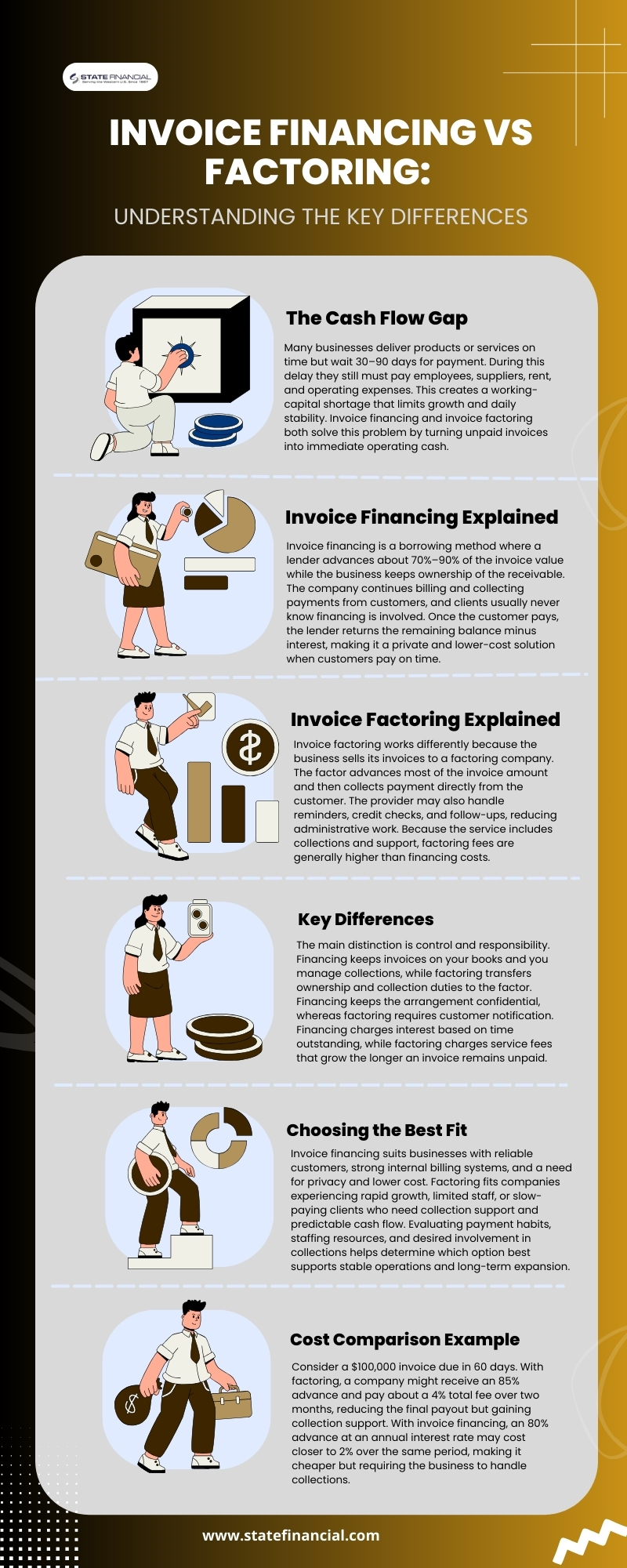
To better understand how each option works, consider a business with a 100000 dollar invoice due in 60 days.
Scenario One: Invoice Factoring
If the factor offers an 85 percent advance and charges a fee of 2 percent every 30 days, the total fee for 60 days is 4 percent or 4000 dollars. You receive 85000 dollars upfront, and the remaining balance is released after customer payment, minus the 4000 dollar fee.
Scenario Two: Invoice Financing
If the lender advances 80 percent and charges 12 percent annually, interest for 60 days equals roughly 2 percent or 2000 dollars. If no additional service fees apply, financing costs significantly less than factoring. However, you must handle all collections.
This comparison shows that factoring may cost more but comes with the benefit of outsourcing collections. Invoice financing may cost less, but it leaves administrative work in your hands.
Benefits of Invoice Financing
Invoice financing can be a powerful tool for businesses that want to maintain operational control and minimize costs. The key benefits include:
- You retain ownership of your invoices.
- Customer relationships remain undisturbed.
- The cost is often lower for businesses with prompt paying clients.
- Privacy is preserved because customers remain unaware of the financing arrangement.
- The funding amount increases as your invoiced sales increase.
Companies that want low cost working capital without involving customers often choose invoice financing.
Benefits of Factoring
Factoring provides advantages that extend beyond funding. Notable benefits include:
- The factoring company handles collections and payment follow ups.
- Credit checking support helps you avoid working with risky customers.
- Funding is fast and can scale quickly with business growth.
- Non recourse options protect you from customer non payment.
- Internal administrative work decreases significantly.
Because of the convenience and support included, many business owners review lists of the Best invoice factoring companies before choosing a partner that matches their industry and goals.
When Invoice Financing is the Better Choice
Invoice financing works particularly well for companies that:
- Prefer complete control of the customer relationship.
- Want a confidential funding structure.
- Have reliable customers who pay quickly.
- Want lower costs based on predictable payment behavior.
- Have the staff and systems to manage collections internally.
Businesses with stable payment cycles often save more with invoice financing.
When Factoring is the Better Choice
Factoring is typically ideal for companies that:
- Need to outsource accounts receivable management.
- Want fast working capital without operational delays.
- Are experiencing rapid growth and increased invoice volume.
- Have customers who frequently pay slowly.
- Want additional services like credit checks and payment tracking.
Many fast growing companies with limited internal resources use factoring to maintain healthy cash flow.
The Role of Invoice Financing for Small Companies
Smaller companies and startups often lack the cash reserves that larger organizations enjoy. When customer payments are delayed, small businesses can face serious operational challenges. This is why invoice financing for small businesses is such an effective tool.
Small companies benefit from invoice financing because:
- Approval depends on customer credit, not the company’s age.
- Funding arrives quickly, often within 24 to 72 hours.
- It enables businesses to take on new orders with confidence.
- It provides a more flexible alternative to traditional loans.
- It helps stabilize cash flow during early growth stages.
Small business owners appreciate invoice financing because it supports expansion without requiring long term debt or additional collateral.
How to Make the Right Choice
Choosing between invoice financing and factoring requires evaluating several factors:
- Do you want privacy in your funding arrangement.
- Are you comfortable handling collections internally.
- Are your customers consistent and timely payers.
- Do you prefer interest based or fee based pricing.
- How much administrative support do you need.
- Do you want to shift payment risk to a third party.
By answering these questions honestly, you can determine which solution aligns with your goals and operational preferences.
Final Thoughts
Both invoice financing and factoring offer valuable ways to improve cash flow. Invoice financing is ideal for businesses that want to maintain control, preserve privacy, and minimize cost. Factoring is a better choice for companies that want quick funding plus administrative and credit support.
Before committing, compare several options, review agreement terms carefully, and calculate the true cost based on your customers’ payment habits. When used strategically, both funding methods can strengthen operations, support growth, and create sustainable financial stability.