




Business growth is rarely a straight line. One month may bring record sales, new customers, and exciting expansion opportunities, while the next may demand higher inventory purchases, additional staffing, or unexpected operational expenses. For many small businesses, the challenge isn’t a lack of demand it’s having enough working capital to keep operations moving while preparing for the next stage of growth.
This is why working capital financing has become an essential tool rather than simply a backup plan. It gives businesses the financial flexibility to manage daily operations, respond to market opportunities, and navigate temporary cash flow fluctuations without disrupting long-term objectives. Whether a company is expanding its product line, taking on larger projects, or investing in marketing initiatives, access to timely funding often determines how quickly those opportunities can be transformed into sustainable growth.
Today’s lending landscape also offers far more options than traditional bank loans alone. Business owners can choose from conventional financing, lines of credit, invoice-based funding, and asset-backed solutions, each designed to address different operational needs. While this variety creates more opportunities, it also makes choosing the right financing solution more challenging.
Businesses exploring Small Business Loans USA have access to a wide range of lenders and funding products, but not every solution aligns with every business model. Selecting the right working capital loan requires more than comparing interest rates. It involves understanding your company’s cash flow, growth objectives, repayment capacity, and long-term financial strategy.
This guide explains how working capital loans support business growth, what factors should influence your decision, and how to identify a financing solution that strengthens your business instead of creating unnecessary financial pressure.
Why Working Capital Is More Important Than Ever
Many business owners assume profitability automatically translates into financial stability. In reality, even successful companies can experience periods where expenses increase faster than available cash. Business growth often requires spending today to generate revenue tomorrow, creating temporary funding gaps that can limit progress if not managed strategically.
Working capital provides the financial flexibility needed to bridge these gaps. Instead of delaying important business decisions because cash is temporarily tied up in operations, companies can continue investing in activities that generate future revenue.
Consider a manufacturer that receives a significantly larger purchase order from a long-term customer. Fulfilling the order may require purchasing additional raw materials, increasing production capacity, and hiring temporary staff. Although the opportunity promises substantial revenue, the business must first cover these expenses before receiving payment. Without sufficient working capital, accepting the contract could become difficult despite strong demand.
Similar situations occur across nearly every industry. Construction companies often need to purchase materials before projects begin. Staffing agencies must process payroll consistently while waiting for client payments. Wholesale distributors frequently invest in inventory well before products are sold. Service businesses may expand their workforce months before new contracts begin generating revenue.
Access to working capital allows businesses to make proactive decisions instead of reactive ones. Rather than postponing growth initiatives, negotiating delayed supplier payments, or reducing operational efficiency, companies can maintain momentum while preserving healthy business relationships.
More importantly, adequate working capital helps businesses remain resilient during changing economic conditions. Rising operating costs, supply chain adjustments, fluctuating customer demand, and inflation continue to influence businesses across nearly every sector. Companies with access to reliable financing are generally better positioned to adapt quickly without compromising service quality or customer satisfaction.
Understanding the Different Types of Working Capital Financing
One of the most common mistakes business owners make is assuming every working capital loan functions the same way. In reality, financing products are designed to solve different business challenges. Choosing the wrong option may increase borrowing costs or create unnecessary repayment pressure, while selecting the right solution can significantly improve financial flexibility.
Traditional term loans remain a popular choice for businesses with strong financial histories and predictable cash flow. These loans provide a fixed amount of capital that is repaid over an agreed period, making them suitable for planned operational investments or business improvements. However, qualification requirements can be more rigorous, particularly for younger businesses or companies with limited credit history.
Business lines of credit offer greater flexibility because funds are accessed only when needed. Instead of receiving one large lump sum, businesses draw capital as expenses arise and pay financing costs only on the amount utilized. This makes a line of credit particularly useful for companies experiencing recurring operational expenses or seasonal fluctuations.
Invoice financing and factoring have also become increasingly popular among businesses whose growth is limited by outstanding receivables rather than profitability. Partnering with an Accounts Receivable Factoring Company enables businesses to convert unpaid invoices into immediate working capital instead of allowing those receivables to remain tied up on the balance sheet. This approach improves liquidity while enabling companies to continue serving customers, accepting larger orders, and investing in growth opportunities.
Asset-based lending represents another flexible financing solution. Rather than relying primarily on credit history, lenders evaluate eligible business assets such as inventory, equipment, or receivables. Businesses with valuable operational assets but inconsistent cash flow often find this option particularly attractive because financing capacity grows alongside the business itself.
The most effective financing solution ultimately depends on your company’s operating model, revenue cycle, customer base, and long-term objectives. Rather than asking which loan offers the lowest rate, business owners should ask which financing structure best supports sustainable growth.
Key Factors to Evaluate Before Choosing a Working Capital Loan
Choosing a lender should never be based solely on how quickly funding becomes available. While speed certainly matters, the long-term value of financing depends on how well the solution aligns with your overall business strategy.
The first consideration should always be the purpose of the financing. Businesses that clearly define how capital will be used typically make stronger borrowing decisions than those seeking funding simply because cash flow feels tight. Whether the objective is increasing inventory, expanding into new markets, hiring additional employees, investing in technology, or managing operational expenses, every financing decision should support measurable business outcomes.
Business owners should also evaluate repayment sustainability rather than focusing exclusively on loan size. Larger funding amounts may appear attractive initially, but repayments should comfortably fit within projected operating cash flow. Financing should strengthen financial flexibility not reduce it by creating unnecessary repayment pressure during slower business periods.
Another important factor is transparency. Unfortunately, many businesses compare financing offers using advertised interest rates alone, overlooking processing charges, maintenance fees, administrative costs, repayment structures, or renewal conditions. Understanding the complete cost of borrowing provides a far more accurate picture of which financing solution offers genuine long-term value.
Finally, consider the lender’s experience within your industry. A financing partner that understands your business model is often better equipped to recommend appropriate funding solutions than a lender applying generic qualification standards. Industry knowledge can lead to more flexible underwriting, faster approvals, and financing structures that reflect the realities of your day-to-day operations rather than relying solely on standardized lending criteria.
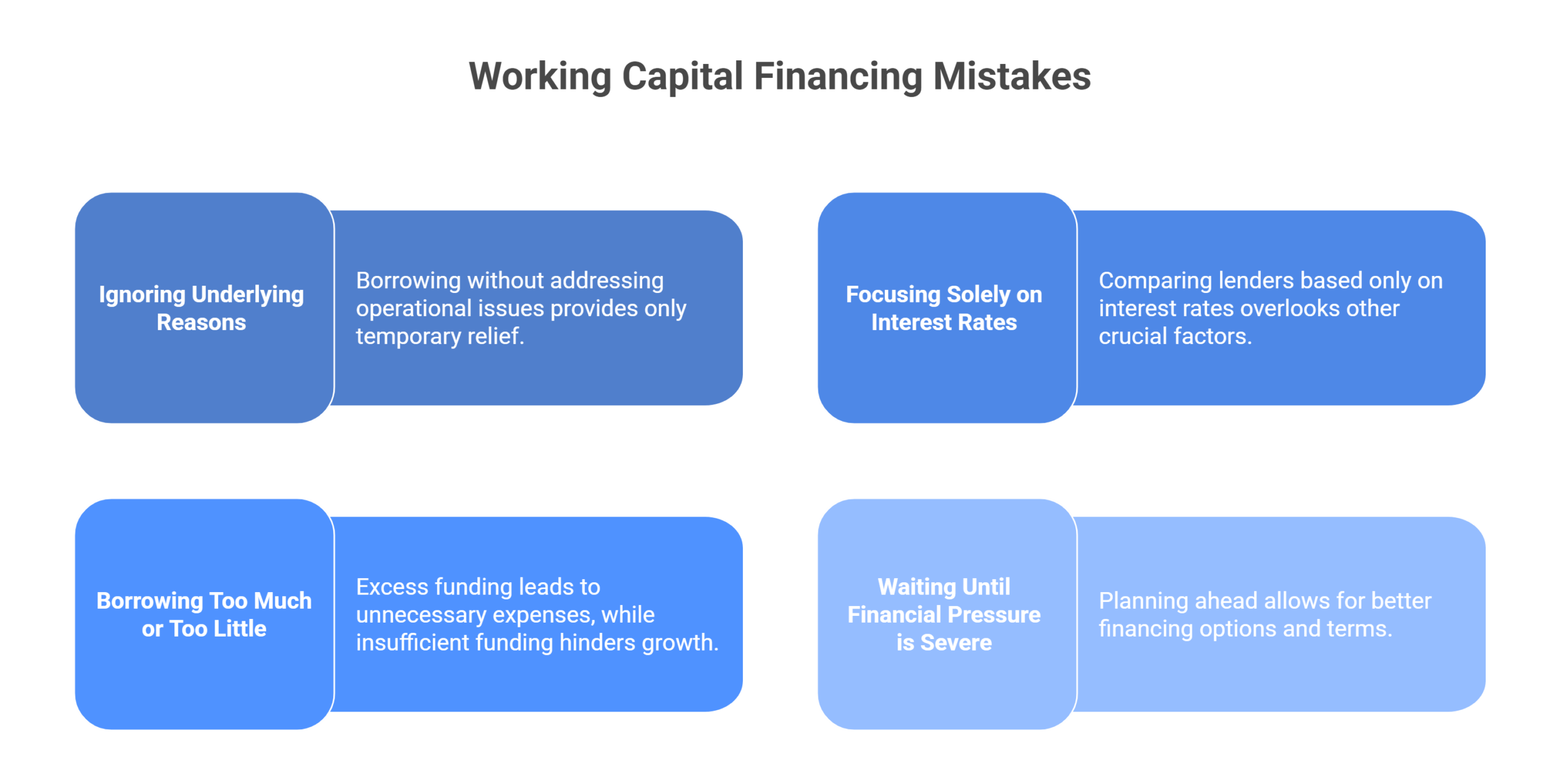
Common Mistakes Businesses Make When Choosing Working Capital Financing
Securing funding is only one part of the equation; choosing the wrong financing solution can create challenges that outweigh its benefits. Many businesses focus on solving an immediate cash flow need without considering how the loan will impact operations over the coming months or years. A more strategic approach begins with understanding the long-term financial implications of every borrowing decision.
One of the biggest mistakes is applying for financing without first identifying the underlying reason cash flow is under pressure. If delayed customer payments, inefficient inventory management, or inconsistent forecasting are causing recurring shortages, borrowing alone may only provide temporary relief. Addressing these operational issues alongside financing creates a stronger foundation for sustainable growth.
Another common error is comparing lenders based solely on interest rates. While borrowing costs certainly matter, they should never be viewed in isolation. Approval speed, repayment flexibility, customer support, funding limits, and the lender’s experience within your industry all contribute to the overall value of a financing solution. In many cases, a slightly higher financing cost may provide significantly greater flexibility and allow a business to capitalize on growth opportunities that would otherwise be missed.
Businesses should also avoid borrowing more than they realistically require. Excess funding often results in unnecessary financing expenses, while borrowing too little may leave critical projects underfunded. Developing a detailed cash flow forecast before applying helps determine the appropriate funding amount and ensures the financing aligns with actual business requirements.
Perhaps the most overlooked mistake is waiting until financial pressure becomes severe before seeking assistance. Businesses generally have access to more financing options when their financial position remains stable. Planning ahead allows owners to compare products carefully, negotiate favorable terms, and choose a solution that supports growth rather than responding to an emergency.
Industry Trends That Are Reshaping Working Capital Lending
The commercial lending industry has changed significantly over the past several years. Businesses now expect financing to be faster, more flexible, and tailored to their specific operating needs rather than relying on standardized lending models.
Technology has played a major role in this transformation. Many lenders now use digital application platforms, automated financial analysis, and real-time data verification to evaluate businesses more efficiently. As a result, approval timelines have shortened considerably, allowing companies to access funding when opportunities arise instead of waiting through lengthy administrative processes.
Another notable trend is the growing emphasis on cash flow performance rather than credit scores alone. While credit history remains an important consideration, many lenders recognize that a healthy business with consistent revenue may deserve financing even if traditional lending criteria are not perfectly met. This broader approach has expanded financing opportunities for businesses across a wide range of industries.
Alternative financing solutions have also become increasingly mainstream. Products such as receivables financing and asset-based lending are no longer viewed as niche funding options. Instead, they have become strategic financial tools for companies seeking to improve liquidity without relying exclusively on conventional bank loans. This shift reflects a broader understanding that different businesses require different funding structures depending on their operating cycles and growth objectives.
Economic uncertainty has further reinforced the importance of financial flexibility. Rising operating expenses, changing customer demand, and evolving supply chains have encouraged many business owners to prioritize access to working capital before challenges arise. Rather than viewing financing as a last resort, successful businesses increasingly incorporate it into their overall financial planning.
Choosing the Right Lending Partner for Long-Term Success
The lender you choose can influence your business well beyond the initial funding process. An experienced lending partner does more than approve applications they take the time to understand your operations, evaluate your objectives, and recommend financing solutions that align with your long-term goals.
Transparency should always be a priority. A reputable lender clearly explains repayment terms, financing costs, eligibility requirements, and funding timelines before any agreement is signed. This level of openness helps businesses make informed decisions while avoiding unexpected surprises later.
Industry expertise is equally valuable. Every sector has unique cash flow patterns, operating expenses, and growth cycles. A lender familiar with your industry is better equipped to structure financing around those realities instead of applying a one-size-fits-all approach.
Businesses operating in highly competitive markets should also consider scalability. As revenue grows, financing needs often change. Establishing a relationship with a lender capable of supporting future expansion can eliminate the need to search for new financing partners every time additional capital is required.
Communication also plays an important role. Business conditions can change quickly, and having access to knowledgeable professionals who can provide guidance when financing needs evolve creates additional value beyond the loan itself.
A Real-World Example of Strategic Working Capital Financing
Imagine a regional food distributor that has built a strong reputation for supplying independent grocery stores and restaurants. After securing several new contracts, customer demand increases significantly, creating an opportunity to expand into neighboring markets.
While the business has the capacity to grow, fulfilling larger orders requires additional inventory, expanded warehouse operations, upgraded transportation, and the recruitment of new employees. Waiting until revenue from these contracts is fully collected would delay expansion and risk losing valuable customers to competitors.
Instead of slowing growth, the company secures working capital financing designed around its operating needs. The additional funding allows management to increase inventory levels, strengthen supplier relationships, invest in logistics, and maintain consistent service quality throughout the expansion period.
Within months, the business successfully enters new markets, increases annual revenue, and improves operational efficiency. More importantly, the financing supports strategic growth rather than simply solving a temporary cash shortage. This illustrates how choosing the right funding solution can become a catalyst for long-term business development rather than just a short-term financial fix.
Why California Businesses Need a Tailored Financing Strategy
California is home to one of the country’s most diverse and competitive business environments. From manufacturing and logistics to technology, healthcare, agriculture, and professional services, businesses often experience unique operational demands that require flexible funding solutions.
Companies researching Small Business Loans California should look beyond basic loan availability and evaluate whether a lender understands the challenges specific to their industry and region. Seasonal demand, supply chain complexity, labor costs, and rapid market changes all influence working capital requirements, making customized financing particularly valuable.
Businesses that choose financing aligned with their operational cycle are generally better positioned to respond to market opportunities, strengthen customer relationships, and invest confidently in future growth.
Conclusion
Choosing the right working capital loan is not simply about accessing additional funds it is about creating the financial flexibility needed to operate with confidence and pursue sustainable growth. Every business has unique objectives, operating cycles, and cash flow patterns, which means there is no universal financing solution that fits every situation. The most effective decision comes from understanding your financial needs, evaluating available funding options carefully, and selecting a lending partner that supports your long-term business strategy.
Whether your goal is expanding operations, investing in inventory, managing seasonal fluctuations, or strengthening day-to-day liquidity, working capital financing can provide the stability needed to move forward without interrupting business momentum. The key is choosing a solution that complements your revenue cycle, offers transparent terms, and grows alongside your business rather than creating unnecessary financial strain.
As the commercial lending landscape continues to evolve, business owners have more financing options than ever before. Taking the time to compare lenders, understand repayment structures, and assess the full value of each funding solution can lead to stronger financial decisions and greater operational resilience.
For businesses seeking reliable funding, experienced guidance can make all the difference. By partnering with a lender that understands your industry, cash flow patterns, and long-term business goals, you can transform working capital from a short-term financial solution into a strategic tool for sustainable growth. Whether you’re expanding operations, investing in new opportunities, or strengthening day-to-day cash flow, choosing the right financing partner can provide the flexibility and confidence needed to navigate challenges and achieve lasting success in an increasingly competitive marketplace.