




The lending landscape is undergoing a major transformation. Artificial intelligence and embedded finance are no longer emerging concepts; they are actively reshaping how businesses and consumers access capital. Traditional lending models depended on lengthy paperwork, manual reviews, and delayed decisions, but today, technology has made financing faster, more accurate, more transparent, and deeply integrated into business workflows.
We are now entering a new era of smarter lending platforms where financing becomes part of daily business operations, not a separate banking task.
Understanding AI and Embedded Finance in Lending
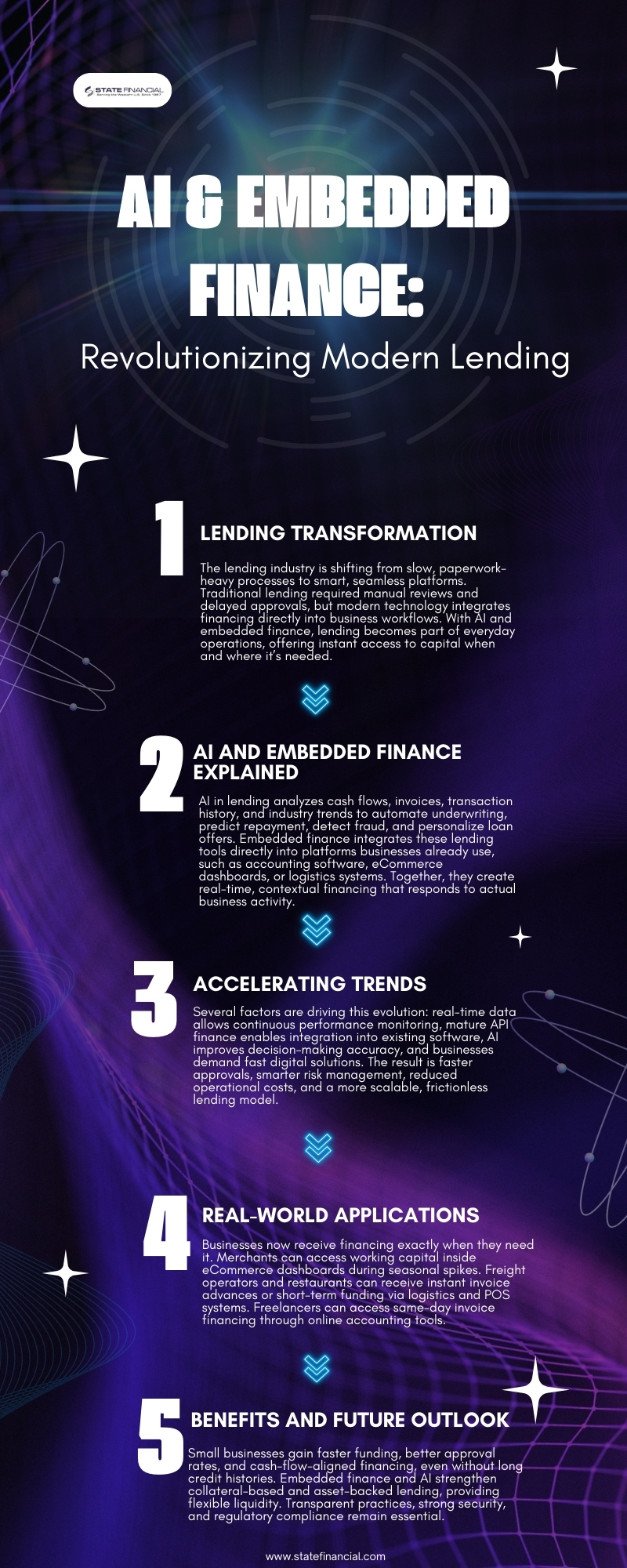
AI in lending increases efficiency by analyzing patterns in behavior, transaction history, cash-flow timing, invoice cycles, and industry performance. It automates underwriting, predicts repayment probability, detects fraud, and personalizes loan structures to each borrower.
Embedded finance integrates lending products directly inside platforms businesses already use such as accounting tools, eCommerce dashboards, logistics software, or payment systems. Instead of applying separately at a bank, a business receives financing at the exact moment it’s needed, inside tools they already trust.
When combined, AI and embedded finance create a system where financing is instant, intelligent, and available at the point of activity. A business raising invoices might see an automatic financing offer when cash flow tightens, or an online seller might receive working capital inside an eCommerce dashboard.
This new lending model is contextual, predictive, and designed around real business behavior.
Why This Evolution Is Accelerating

Several forces are driving this shift in the lending industry:
Modern business data streams are now real time, enabling lenders to monitor performance continuously instead of waiting for quarterly statements.
API finance has matured, making it easier for banks and fintechs to plug lending solutions directly into software products.
AI algorithms now outperform manual evaluation, identifying deeper trends and reducing turnaround time drastically.
Businesses expect fast digital solutions, and lenders must keep pace or lose customers.
With these drivers combined, lending is evolving beyond paperwork into a frictionless, intelligent, and highly scalable model.
Faster Decisions and Smarter Risk Management
AI-enabled lending platforms offer measurable improvements in performance and risk control.
Underwriting times have dropped from days to minutes, improving customer experience.
Operational costs fall significantly due to automation and reduced manual review needs.
Fraud is easier to detect, as AI identifies anomalies in spending, invoicing, or identity verification.
Risk models become proactive, adjusting credit exposure in real time based on cash flow changes.
Approval rates increase, especially for businesses with limited credit history but strong operational data.
This trio of speed, accuracy, and reduced risk makes AI and embedded finance not just a convenience but a new competitive standard.
Invoice Finance and Real-Time Loan Offers
Industries based on invoices and supply chains are already experiencing transformation. Business owners can now receive instant working capital based on real-time receivables and sales activity, built directly into their invoicing tools. This is dramatically changing how companies interact with receivables factoring companies, because access to financing becomes automatic, seamless, and fast.
Instead of submitting documents or waiting for approvals, AI evaluates invoice behavior, buyer reliability, repayment history, and cash-flow data, making capital available in minutes.
Cash flow no longer stalls business growth.
Examples of Embedded Lending in Action
Below are real-life use cases showing how embedded finance meets business needs instantly:
Merchants experiencing seasonal sales spikes receive working capital offers directly in their eCommerce dashboards.
Transport companies completing freight loads receive instant invoice advance options inside logistics platforms.
Restaurants managing inventory with point-of-sale systems get short-term working capital offers to restock supplies.
Freelancers billing through online accounting apps receive same-day invoice financing offers at the time of invoice creation.
This model strengthens business stability and keeps companies funded without breaking their workflow.
AI’s Role in Credit Assessment and Loan Pricing
AI powers smarter lending decisions in multiple ways:
Automated data gathering from accounting, sales systems, payment histories, and market behavior.
Real-time credit scoring that updates continuously instead of relying on outdated files.
Dynamic credit limits that rise as business performance improves.
Fraud prevention capabilities that flag suspicious identity or financial behavior instantly.
Customized loan offers that match borrower risk profiles and revenue cycles.
The result is data-driven financing that reduces defaults, lowers costs, and improves borrower access.
AI Strengthening Modern Collateral-Based Financing
AI and embedded finance strengthen models where business performance and assets support lending. By pairing algorithmic intelligence with business asset evaluation, modern financing platforms complement the discipline of Asset based Lending models and provide more flexible liquidity driven by real market behavior.
This evolution allows lenders to offer facilities that grow alongside business performance and adjust during slow periods, creating safer lending and healthier business cash flow.
Small Business Advantages
For smaller companies and mid-market operators, this technological evolution provides:
Fast access to funds for operations and expansion
Better approval rates for non-traditional borrowers
No heavy paperwork requirements
Funding aligned with the company’s actual revenue and timing
Lower stress and improved cash-flow management
A small company using accounting software could immediately access capital based on receivables without waiting for lengthy credit investigations. Similarly, an accounts receivable financing company integrated into business systems can approve a cash advance the moment an invoice is issued.
This shift levels the playing field for entrepreneurs, especially those without long credit histories or large banking relationships.
Compliance, Security, and Fairness
Even with technology leading the process, responsible practices remain essential:
Transparent pricing and fees
Clear borrower communication
Strong data security protocols
Bias-free AI training processes
Regulatory compliance monitoring
Human oversight on complex lending decisions
Trust remains the foundation of any lending relationship, and modern systems must combine automation with fairness and accountability.
Preparing for the Future of Lending
Forward-thinking lenders are already building technology-first lending ecosystems with:
Strategic integration partners and API connectivity
Machine-learning-driven scoring models
Continuous portfolio monitoring
Embedded financing options built directly into business software
Customer-centric lending experiences
The institutions that embrace automation, transparency, and embedded distribution will lead the next decade of lending.
Conclusion
AI and embedded finance are reinventing lending by shifting decision-making from manual processes to automation, intelligence, and real-time data insights. Capital is no longer tied to bureaucracy. It now flows when business activity proves the need.
Small businesses receive quicker, more reliable cash-flow support. Lenders cut losses and improve speed. Platforms become growth engines instead of just software tools.
This new model creates faster, smarter, fairer, and more inclusive lending access. The transformation is already underway, and as technology advances, the future of lending will be intelligent, embedded, and instant.