




Starting a business is an exciting journey filled with ambition, innovation, and opportunity. Yet, one of the biggest challenges most startups face is securing enough funding to turn their ideas into sustainable businesses. While traditional bank loans and venture capital often take center stage in business financing, they’re not always the most accessible or flexible options for new entrepreneurs. That’s where alternative business financing comes in providing practical, faster, and more adaptable funding solutions for startups that want to grow without giving away equity or waiting months for approvals.
This article explores what alternative financing means, why it’s gaining popularity, and the most effective funding options available today. Whether you’re building a tech startup, a service-based company, or an e-commerce brand, understanding these options can help you keep your business cash flow healthy and your operations scalable.
Why Alternative Financing Matters More Than Ever
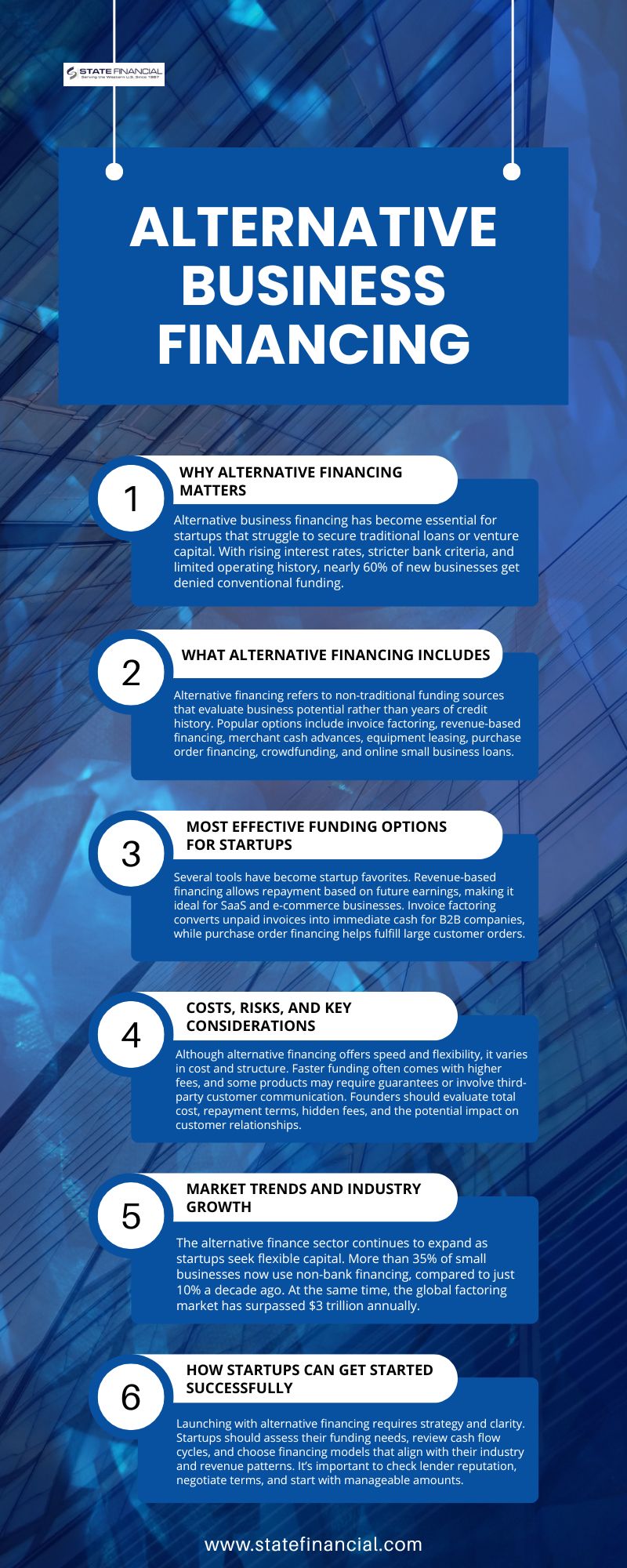
The business financing landscape has changed dramatically in recent years. Rising interest rates, tighter lending criteria, and reduced venture capital activity have pushed many founders to look for creative funding alternatives. According to recent small business studies, nearly 60% of startups report being denied traditional loans due to limited operating history, insufficient collateral, or inconsistent cash flow.
Alternative financing bridges this gap. It’s built for the real challenges startups face unpredictable revenue, rapid growth needs, and a lack of long-term credit history. Instead of focusing solely on collateral or years of profitability, many modern lenders evaluate business potential, receivables, and future revenue streams.
These solutions are especially useful for startups that can’t afford long waits for funding approvals or are hesitant to give up ownership to investors.

Understanding Alternative Business Financing
Alternative business financing refers to non-traditional funding sources outside conventional banks and investors. These options include:
- Invoice factoring and receivables financing
- Revenue-based financing
- Merchant cash advances
- Equipment leasing
- Crowdfunding
- Purchase order financing
- Online business loans
The goal is to give startups access to the capital they need, quickly and without the rigid terms of bank loans or the equity loss that comes with venture funding.
1. Bootstrapping and Personal Capital
Every business starts with some form of investment. For many founders, that means using their own savings or personal credit to launch operations. This is called bootstrapping using internal resources rather than external funding.
Bootstrapping keeps ownership and decision-making in your hands, but it can also limit how fast you can grow. When early expenses like marketing, hiring, and production costs start to rise, bootstrapped founders often need a cash injection to scale. That’s where other forms of alternative financing step in.
2. Small Business Loans and Credit Lines
Traditional lenders like banks and credit unions may be hesitant to lend to startups, but many alternative and fintech lenders have streamlined the process for small business financing. These companies evaluate revenue potential and real-time financial data rather than just historical performance.
In the small business loans USA market, alternative lenders have significantly grown their share, offering faster approvals, lower documentation requirements, and flexible repayment terms. Startups can apply online and receive funding in days instead of months.
These loans are ideal for businesses that have consistent sales and want to expand without giving up equity. However, interest rates can vary depending on your credit profile and business cash flow.
3. Revenue-Based Financing (RBF)
Revenue-based financing is an excellent fit for startups with recurring revenue or strong growth potential but without assets to pledge. In this model, a lender advances capital in exchange for a percentage of the business’s future revenue. Repayments fluctuate with your earnings higher in good months, lower when sales dip.
RBF doesn’t require personal guarantees or collateral, and since payments are tied to revenue, it offers more flexibility than fixed loan payments. It’s particularly popular among SaaS companies and e-commerce startups.
4. Invoice Factoring and Receivables Financing
For B2B startups that invoice customers and wait 30 to 90 days for payment, cash flow delays can be a major challenge. Invoice factoring and receivables financing solve this by converting unpaid invoices into immediate cash.
In invoice factoring, you sell your accounts receivable to a factoring company at a discount. They advance 70–90% of the invoice amount upfront and pay the remaining balance (minus fees) once your client pays.
Receivables financing works slightly differently you borrow against the value of your invoices rather than selling them. This lets you retain customer relationships while accessing working capital faster.
The demand for these solutions is rising rapidly. Industry reports estimate that the global factoring market exceeds $3 trillion annually and continues to grow as businesses prioritize liquidity and flexibility. Many receivables factoring companies now operate digitally, offering fast onboarding and transparent pricing for startups across industries.
5. Purchase Order Financing
Purchase order (PO) financing is ideal for startups that have secured a large customer order but lack the funds to fulfill it. A financing company pays your supplier directly to produce or deliver goods. Once your customer pays, the financier takes their portion and releases the rest to you.
This helps startups grow without turning away big orders due to limited capital. It’s particularly useful in manufacturing, wholesale, and e-commerce businesses where demand can spike unexpectedly.
6. Merchant Cash Advances (MCAs)
For businesses that receive most of their payments via credit cards, merchant cash advances provide quick access to funds. The lender advances a lump sum, which you repay automatically as a small percentage of daily credit card sales.
The advantage is speed funds can arrive within 24–48 hours. The downside is cost, as MCAs often carry high effective interest rates. They should be used sparingly, ideally for short-term needs like inventory purchases or marketing campaigns.
7. Equipment Leasing and Asset Financing
Startups in manufacturing, construction, or tech often need expensive equipment to operate. Equipment leasing allows you to use necessary machinery without paying the full cost upfront.
With asset financing, you can borrow against the value of your existing equipment, freeing up capital for other expenses. Leasing keeps your balance sheet lighter and preserves cash flow while giving access to the latest technology and tools.
8. Crowdfunding and Peer-to-Peer Lending
Online crowdfunding platforms have revolutionized startup funding. Entrepreneurs can raise small amounts of money from a large number of people who believe in their product or mission. There are two main types:
- Reward-based crowdfunding, where backers receive a product or perk.
- Equity crowdfunding, where contributors receive shares in your company.
Peer-to-peer (P2P) lending platforms, on the other hand, connect borrowers directly with investors who are willing to lend money at agreed interest rates. These methods bypass traditional institutions entirely and can be excellent for innovative or niche projects.
9. Receivables Financing and Working Capital Optimization
Beyond simple factoring, some advanced fintech platforms specialize in ongoing receivables financing programs. They integrate with your accounting system and continuously evaluate outstanding invoices to provide flexible lines of credit.
This gives startups the ability to draw funds as needed, similar to a revolving credit line but based on actual receivables rather than credit history. This model helps stabilize cash flow, reduce reliance on short-term loans, and strengthen supplier relationships.
Startups that use these programs often see a 20–30% improvement in cash-flow predictability, allowing them to plan growth activities with confidence. Many innovative receivables financing companies also use AI-based analytics to evaluate risk more accurately and offer lower rates for consistent payment histories.
The Cost Equation — What to Watch For
Alternative financing offers speed and flexibility, but it’s important to understand the costs and trade-offs. Some products can be more expensive than traditional loans, especially if your credit profile or customer payment behavior is inconsistent.
Here’s what to consider:
- Total cost vs. speed: The faster you get funds, the higher the cost tends to be.
- Recourse terms: In factoring, decide whether you or the factor bears the risk if a client doesn’t pay.
- Hidden fees: Look for administrative or service fees that increase the total repayment.
- Impact on customer relations: Some factoring providers handle collections directly; ensure they align with your company’s professionalism.
Comparing multiple offers and reading the fine print can save your startup thousands in unnecessary costs.
Market Trends and Industry Insights
The U.S. alternative finance market has been expanding steadily as startups seek agile capital sources. Reports suggest that over 35% of small businesses now use some form of alternative financing from invoice factoring to crowdfunding compared to just 10% a decade ago.
Additionally, the global receivables factoring sector continues to grow due to digital platforms, transparent pricing, and the rising number of fintech-driven lenders. With AI-powered credit analysis and automation, funding that used to take weeks can now be completed in hours.
This shift toward alternative business financing is expected to continue, especially as startups value flexibility and control over long-term commitments or equity dilution.
A Step-by-Step Guide to Getting Started
- Assess your needs: Identify what you need funding for working capital, inventory, payroll, or expansion.
- Review cash flow cycles: Understand your receivables turnover and payment delays.
- Shortlist options: Compare lenders that specialize in your industry.
- Check reputation: Work with well-established and transparent providers.
- Negotiate terms: Advance rates, fees, and duration are often flexible.
- Start small: Test one financing method before scaling up.
The Bottom Line
Alternative business financing has made it possible for startups to grow faster, operate smarter, and remain independent. Whether through factoring, equipment leasing, or online small business loans, entrepreneurs now have more choices than ever to fund their operations.
By understanding how each method works and choosing wisely you can create a healthy financial structure that supports your business’s long-term vision. The best strategy isn’t about finding the cheapest capital but choosing the right capital that fits your growth stage, goals, and cash flow rhythm.
With thoughtful planning and the right partner, your startup can stay liquid, flexible, and ready to seize every opportunity that comes its way.