Many small business owners focus heavily on sales, customers, and marketing. However, one of the biggest factors behind long term success is something less visible: understanding financial performance. A business may appear profitable because money is coming in, yet still struggle to pay bills. This confusion usually comes from relying only on bank balances instead of proper accounting.
This is where accrual accounting becomes important. It is not just a technical accounting concept. It is a system that helps you clearly understand how your business is actually performing. Once a business grows beyond basic operations, accrual accounting becomes a foundation for stability, growth, and smarter decision making.
In this guide, you will learn how accrual accounting works, why it matters, and how small businesses can use it effectively.
What Is Accrual Accounting?
Accrual accounting is an accounting method that records income when it is earned and records expenses when they are incurred, regardless of when cash is received or paid.
In simple terms:
- You record revenue after completing work or delivering goods.
- You record expenses when you become responsible for paying them.
The timing of payment does not matter. What matters is when the economic activity actually happened.
Simple Example
Suppose you run a marketing agency and complete a project worth ₹1,50,000 in May. You send an invoice with 30 day payment terms, and the client pays in June.
Under accrual accounting:
- Revenue is recorded in May
Under cash accounting:
- Revenue is recorded in June
The work was done in May, so accrual accounting reflects reality more accurately.
Accrual Accounting vs Cash Accounting
Small businesses usually start with cash accounting because it is easy. But as they grow, it becomes less reliable.
| Cash Accounting | Accrual Accounting |
| Records transactions when money moves | Records transactions when they occur |
| Simple to maintain | More informative |
| Limited financial insight | Accurate performance tracking |
| Not suitable for growing companies | Preferred for scaling businesses |
Cash accounting tracks your bank account. Accrual accounting tracks your business activity.
A company can collect large advance payments and appear profitable even though it has not earned that income yet. Likewise, it may look unprofitable during a slow payment period even though it completed significant work. Accrual accounting prevents these misleading situations.
Why Small Businesses Need Accrual Accounting
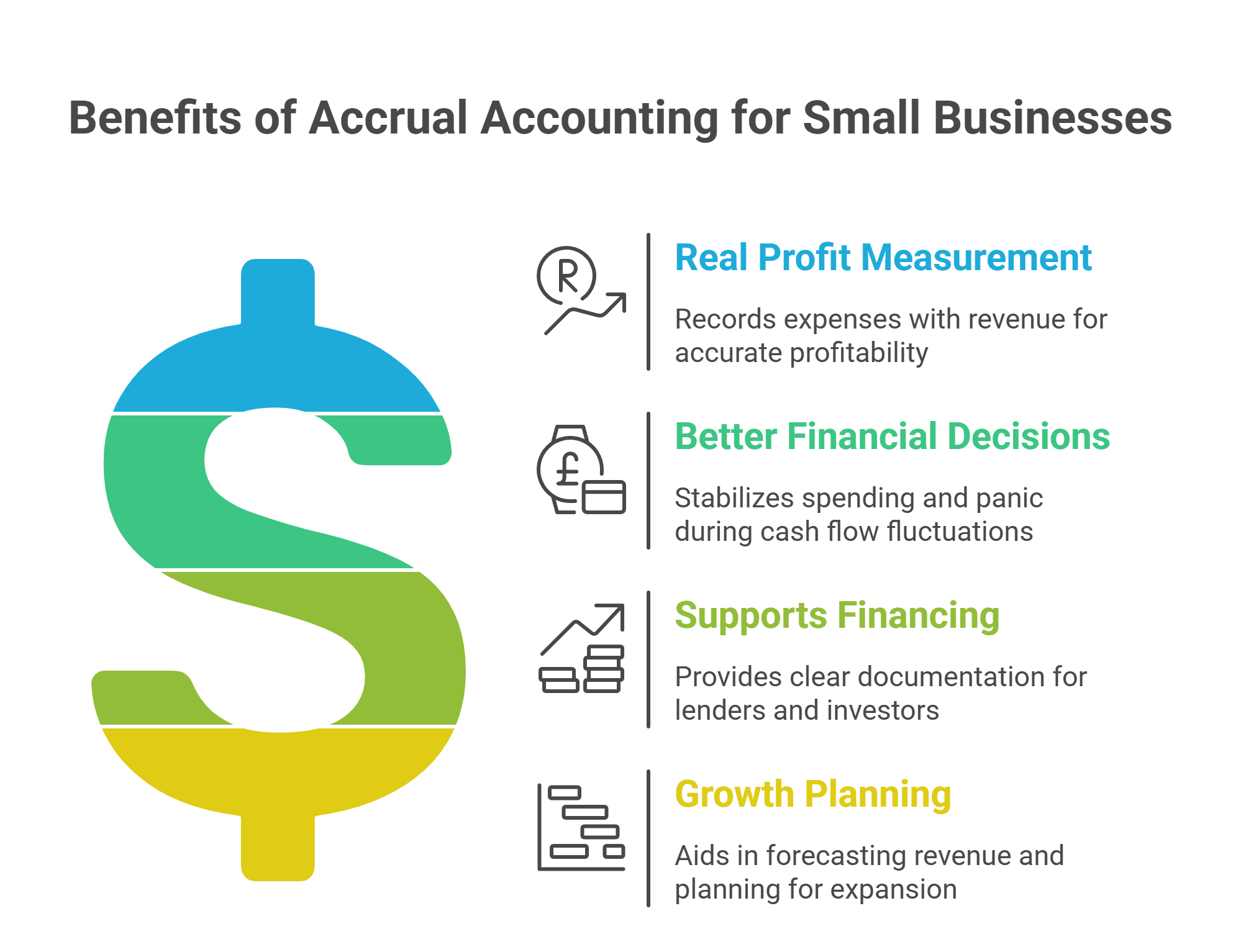
1. Shows Real Profit
Accrual accounting follows the matching principle. Expenses are recorded in the same period as the revenue they helped generate. This gives a true measure of profitability.
2. Better Financial Decisions
When business owners rely only on cash, they often overspend during high-cash months and panic during slow collections. Accrual accounting stabilizes decision making.
3. Supports Financing
Lenders and investors want to see reliable financial statements. If you ever approach an accounts receivable financing company, your invoices, payment cycles, and earned revenue must be documented clearly. Accrual records provide that clarity.
4. Growth Planning
Accrual accounting helps you:
- Forecast revenue
- Anticipate expenses
- Prepare hiring decisions
- Plan inventory purchases
Core Elements of Accrual Accounting
To understand accrual accounting, you must understand its components.
Accounts Receivable
Money customers owe you after you provide a product or service. It is recorded as income even before payment is received.
Accounts Payable
Bills you owe vendors or suppliers. These are expenses even before payment is made.
Accrued Expenses
Expenses that have occurred but have not yet been billed.
Examples:
- Wages earned by employees
- Utility usage
- Professional services
Deferred Revenue
Money received before completing work. It is recorded as a liability until the service is delivered.
The Matching Principle
The matching principle is the core idea behind accrual accounting. It connects income with related expenses.
Example:
You sell products worth ₹4,00,000 in February, but the inventory cost was ₹2,40,000 purchased in January.
Accrual accounting records both the revenue and cost in February. This gives the true profit:
Profit = ₹1,60,000
Without matching, financial statements would be misleading and inconsistent.
Financial Statements in Accrual Accounting
Accrual accounting produces three important reports.
Income Statement
Shows revenue, expenses, and profit over a specific period.
Balance Sheet
Shows:
- Assets
- Liabilities
- Owner equity
This is where receivables and payables appear.
Cash Flow Statement
Separates actual cash movement from profit. This report is essential because profit does not always equal available cash.
Benefits for Growing Businesses
Accurate Performance Measurement
You can evaluate which products or services are actually profitable.
Easier Budgeting
Future financial planning becomes more reliable.
Improved Creditworthiness
Banks and lenders trust accrual financial statements more than cash records.
Businesses that use Asset based Lending often rely on receivables, inventory, and financial reporting. Accrual accounting clearly presents these assets.
Investor Confidence
Investors want predictable earnings. Accrual accounting demonstrates consistency and stability.
Cash Flow vs Profit
A major lesson every business owner learns:
A profitable business can still run out of cash.
Example:
You complete ₹12,00,000 worth of work but customers take 60 days to pay. Your financial statement shows profit, yet you may struggle to pay rent, payroll, or suppliers.
That is a cash flow problem, not a profitability problem.
This is why some businesses work with accounts receivable factoring companies to access working capital tied up in unpaid invoices.
When Should You Switch to Accrual Accounting?
You should strongly consider switching when:
- You offer payment terms to customers
- You carry inventory
- Revenue is growing
- You plan to apply for financing
- You need reliable financial reporting
Most service businesses need it once they start invoicing regularly.
Challenges of Accrual Accounting
More Recordkeeping
You must track invoices, bills, and financial statements regularly.
Taxes on Earned Income
You may pay taxes on revenue that has not yet been collected.
Requires Discipline
Monthly reconciliation and bookkeeping become essential.
Despite these challenges, the benefits greatly outweigh the effort.
How to Implement Accrual Accounting
Step 1: Use Accounting Software
Choose software that tracks invoices, payables, and reports.
Step 2: Record Revenue Immediately
Create invoices right after delivering goods or services.
Step 3: Record Expenses When Incurred
Enter supplier bills as soon as they arrive.
Step 4: Monitor Receivables
Review unpaid invoices weekly.
Step 5: Close Books Monthly
Prepare financial reports every month instead of waiting until year end.
Common Mistakes to Avoid
- Recording revenue only when cash is received
- Ignoring unpaid invoices
- Not tracking vendor bills
- Mixing personal and business finances
- Failing to reconcile accounts
Avoiding these mistakes ensures accurate financial reporting.
Final Thoughts
Accrual accounting transforms the way a small business understands money. Instead of reacting to bank balances, you gain a clear view of performance, obligations, and profitability.
Cash accounting answers one question:
How much money do I have today?
Accrual accounting answers a more important one:
How healthy is my business?
For businesses planning growth, hiring employees, seeking financing, or managing clients with payment terms, accrual accounting is no longer optional. It becomes a strategic tool. When used properly, it improves decision making, builds credibility, and provides the financial insight needed for long term success.