




The mortgage industry is undergoing a fundamental transformation. In an environment shaped by higher interest rates, rising property values, and stricter regulatory oversight, traditional methods of evaluating mortgage risk are no longer sufficient. Lenders are searching for smarter, data-driven ways to measure borrower resilience and asset-based lending (ABL) is emerging as a major force reshaping how mortgage risk is managed.
This shift is not just about new loan products; it represents a deeper evolution in how lenders perceive collateral, creditworthiness, and cash flow stability. Asset-based lending provides a flexible, collateral-focused framework that enhances security for lenders while opening new doors for borrowers who may not fit neatly into traditional underwriting models.
Understanding Asset-Based Lending
Asset-based lending is a type of financing where loans are secured by a company’s assets typically accounts receivable, inventory, equipment, or property. Unlike conventional lending that primarily relies on cash flow projections or credit scores, ABL emphasizes the underlying value and liquidity of a borrower’s tangible assets.
In mortgage lending, this approach can be particularly powerful. It allows lenders to look beyond traditional income statements and credit ratings to assess the borrower’s full financial picture. By leveraging assets as collateral, lenders can structure more flexible loans while maintaining a lower risk profile.
For example, a business owner seeking to refinance a property may not qualify under standard mortgage terms if recent profits have been inconsistent. However, if the company holds strong receivables or valuable equipment, these assets can be used to secure additional funding reducing the perceived risk for the lender.
The Changing Landscape of Mortgage Risk
Mortgage risk has always revolved around two primary concerns: the borrower’s ability to repay and the value of the underlying property. However, as economic conditions fluctuate and business models evolve, those traditional metrics don’t always capture the full picture.
Recent data from mortgage associations have shown a gradual increase in early-stage delinquencies among both residential and commercial borrowers. Inflationary pressure and elevated borrowing costs have tightened liquidity for small and medium-sized enterprises, which in turn can affect their ability to service debt tied to real estate.
This is where asset-based lending makes a significant difference. By considering additional collateral sources such as receivables, inventory, or other tangible assets, lenders can better anticipate risks before they manifest as missed payments or defaults. In other words, ABL allows lenders to manage exposure proactively rather than reactively.

How Asset-Based Lending Changes the Risk Equation
Integrating asset-based lending principles into mortgage underwriting introduces several key advantages:
1. Collateral Diversification
Traditional mortgages are secured by property alone. ABL structures, however, may combine property with other asset classes such as receivables or inventory. This layered collateral approach spreads risk across multiple asset types, reducing the lender’s exposure to market-specific downturns. For instance, even if real estate values fluctuate, other assets may maintain stable or even rising value, offsetting potential losses.
2. Dynamic Borrowing Base
One hallmark of asset-based lending is the concept of a “borrowing base,” which represents the maximum loan amount determined by the current value of eligible collateral. This base is periodically recalculated as collateral values change, ensuring that the loan remains adequately secured. When applied to mortgage portfolios, borrowing-base adjustments act as an automatic safeguard against overexposure.
3. Enhanced Monitoring and Transparency
Unlike traditional mortgages, which may be reviewed annually, ABL arrangements often require frequent reporting on asset performance such as updated receivable aging reports or inventory valuations. This ongoing transparency gives lenders a real-time view of the borrower’s financial health, allowing early detection of potential liquidity issues.
4. Improved Pricing Precision
Because asset-based lending directly links risk to collateral quality, lenders can price loans more precisely. Borrowers with liquid and easily verifiable assets can secure more favorable rates, while those with less transparent or illiquid collateral may face higher costs. This dynamic pricing model encourages responsible borrowing and stronger risk alignment.
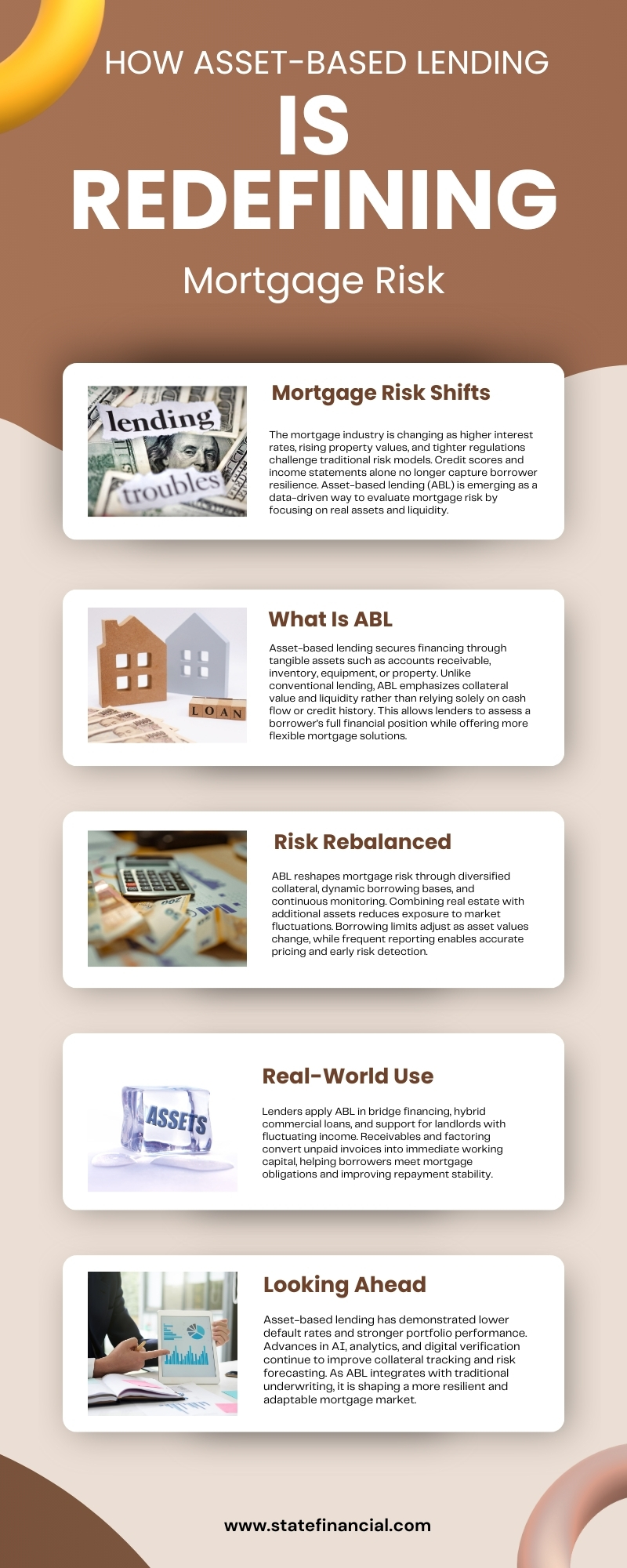
Real-World Applications in Mortgage Markets
Mortgage lenders and alternative finance providers are increasingly using ABL principles to design hybrid structures that mitigate risk while expanding access to credit. For example:
- Bridge Financing for Property Investors: Real estate investors who need short-term funding can use asset-backed loans to cover renovation costs or bridge gaps before refinancing into a conventional mortgage.
- Commercial Borrowers with Mixed Collateral: Businesses that own property and also generate revenue through receivables or inventory can secure financing that uses both real estate and operational assets as collateral.
- Small Landlords and Owner-Operators: These borrowers often have fluctuating cash flows due to seasonal rental demand or maintenance costs. ABL facilities based on receivables or rent rolls can stabilize cash flow and prevent missed mortgage payments.
This flexibility is especially valuable in times of market uncertainty, when access to liquidity can determine whether a borrower survives financial turbulence or faces foreclosure.
The Role of Receivables and Factoring
Receivables play a central role in the success of asset-based lending. When businesses experience cash flow gaps due to delayed customer payments, they can convert invoices into immediate working capital through factoring. This process provides liquidity without taking on additional debt, allowing businesses to meet mortgage or loan obligations on time.
In recent years, receivables factoring companies have become an integral part of the broader lending ecosystem. They help small and mid-sized firms turn unpaid invoices into cash, which in turn stabilizes their ability to manage real estate or mortgage-linked commitments. This interconnectedness between factoring and ABL strengthens the entire credit chain, benefiting both lenders and borrowers.
The Data Behind the Shift
Industry data supports the growing relevance of asset-based finance in reducing credit risk:
- The global asset-based lending market has surpassed hundreds of billions of dollars in annual volume, with projections for steady growth as more institutions adopt collateral-driven models.
- Surveys from financial associations indicate that lenders using ABL frameworks report lower default rates in comparable credit segments due to enhanced collateral visibility.
- Mortgage delinquency data from 2024 and 2025 show that property-backed loans supplemented with additional asset collateral demonstrate stronger repayment performance, even during volatile economic periods.
These numbers underscore a broader truth: diversifying collateral and continuously monitoring asset performance allows lenders to detect early signs of financial stress and act before defaults occur.
Challenges and Considerations
While asset-based lending offers clear benefits, it also introduces new complexities:
1. Valuation Accuracy
Maintaining up-to-date valuations of collateral is crucial. Overestimating asset value can create a false sense of security, while underestimating it may limit borrowing potential. Lenders typically use conservative advance rates to mitigate this risk.
2. Administrative Complexity
ABL loans often require regular financial reporting, audits, and inspections. Smaller borrowers may find this level of oversight burdensome unless supported by modern accounting technology.
3. Legal Structuring
Establishing clear security interests and ensuring priority over other creditors requires careful legal drafting. In complex portfolios, overlapping claims can create challenges in enforcing collateral rights.
4. Market Liquidity
Not all assets are equally liquid. Inventory or specialized equipment may be harder to sell quickly compared to receivables or real estate. Therefore, lenders must evaluate how easily each collateral type can be converted to cash.
Technology’s Impact on Asset-Based Mortgage Lending
Modern technology is transforming how asset-based lending operates. Artificial intelligence and data analytics tools now enable lenders to track collateral values in real time, identify trends, and flag anomalies that might indicate borrower distress. Cloud-based accounting integrations allow automatic updates on receivables and inventory levels, reducing manual reporting burdens.
In addition, digital verification platforms help lenders confirm invoice authenticity and detect fraud, while machine learning algorithms can forecast asset depreciation or cash flow shortfalls before they impact repayment. These advancements are making ABL a more precise, scalable, and efficient way to manage mortgage-related risk.
Use Case: Accounts Receivable Financing in Real Estate
Consider a small property management company that collects rent payments from multiple tenants. When economic slowdowns cause delayed payments, cash flow tightens, putting mortgage obligations at risk. Partnering with an accounts receivable financing company allows the firm to access immediate capital based on pending invoices, maintaining liquidity until rent collections normalize.
This strategy not only helps sustain mortgage payments but also enhances the company’s credit profile. Lenders, in turn, view the borrower as lower-risk because of improved cash flow predictability.
The Growing Role of Asset-Based Lending in the U.S.
Asset based Lending is gaining traction across the United States as both banks and nonbank financial institutions expand their collateral-based products. With the Federal Reserve maintaining higher benchmark rates and tighter lending conditions, traditional loan qualification criteria have become more restrictive. ABL fills the gap, providing a practical solution for businesses and investors who need liquidity without taking on excessive risk.
Industry analysts expect continued growth in asset-based finance as more mortgage lenders integrate these principles into their underwriting models. The approach aligns with the broader trend toward data-driven, collateral-rich lending a trend that emphasizes real value over paper credit scores.
The Outlook: A More Resilient Mortgage Market
The future of mortgage lending lies in integration, not replacement. Asset-based lending complements traditional underwriting rather than competing with it. By combining cash flow analysis with collateral assessment, lenders create a more complete risk model one that recognizes both the borrower’s capacity and the tangible resources backing their obligations.
In the coming years, expect to see wider adoption of hybrid loan structures that blend mortgage and asset-backed features. These products will appeal to business owners, investors, and lenders alike for their flexibility, transparency, and stability.
Conclusion
Mortgage risk is evolving and so are the tools to manage it. Asset-based lending is redefining how lenders evaluate borrowers, measure exposure, and protect portfolios against uncertainty. By leveraging the real, measurable value of assets, lenders gain stronger control over credit quality and loss mitigation. Borrowers, in turn, benefit from greater flexibility and access to capital when traditional financing falls short.
In an economic climate marked by volatility and tighter liquidity, this shift toward asset-based lending represents not just an innovation, but a necessary evolution. It’s reshaping mortgage risk management from the ground up turning collateral from a static safeguard into a dynamic instrument for growth, stability, and long-term success.
You can also Read: Asset Based Mortgages: The Future of Flexible Lending