




Running a small business often means managing multiple financial obligations, from term loans and business credit cards to equipment financing and short-term working capital. When these payments become difficult to coordinate, Business Debt Consolidation can help simplify repayment and improve cash flow. It involves combining several existing business debts into one new loan with a single payment schedule. However, consolidation is not always the right choice. Business owners need to evaluate interest rates, repayment terms, fees, and their company’s financial position before deciding to combine loans.
What Is Business Debt Consolidation?
Business debt consolidation is a financing strategy that allows a company to replace multiple outstanding debts with one new loan. Instead of making separate payments to different lenders, the business uses the new financing to pay off its existing obligations and follows a single repayment schedule.
For example, imagine a business has three outstanding debts:
- A term loan with a remaining balance of $35,000.
- A business credit card balance of $15,000.
- Short-term working capital financing of $20,000.
The total outstanding debt is $70,000. Rather than managing three different payment schedules, the business could apply for a $70,000 consolidation loan, provided it qualifies and the financing covers the full payoff amounts.
The main objective is to make repayment more manageable. Depending on the new loan’s interest rate and repayment period, consolidation may also reduce borrowing costs or free up monthly cash flow.
However, a lower monthly payment does not automatically mean lower overall costs. Extending repayment over a longer period can increase the total interest paid.
When Does Business Debt Consolidation Make Sense for Small Businesses?
Combining small business loans can be helpful when existing debt starts affecting daily operations. However, the decision should be based on the company’s financial condition rather than convenience alone.
Here are some situations where consolidation may be worth considering.
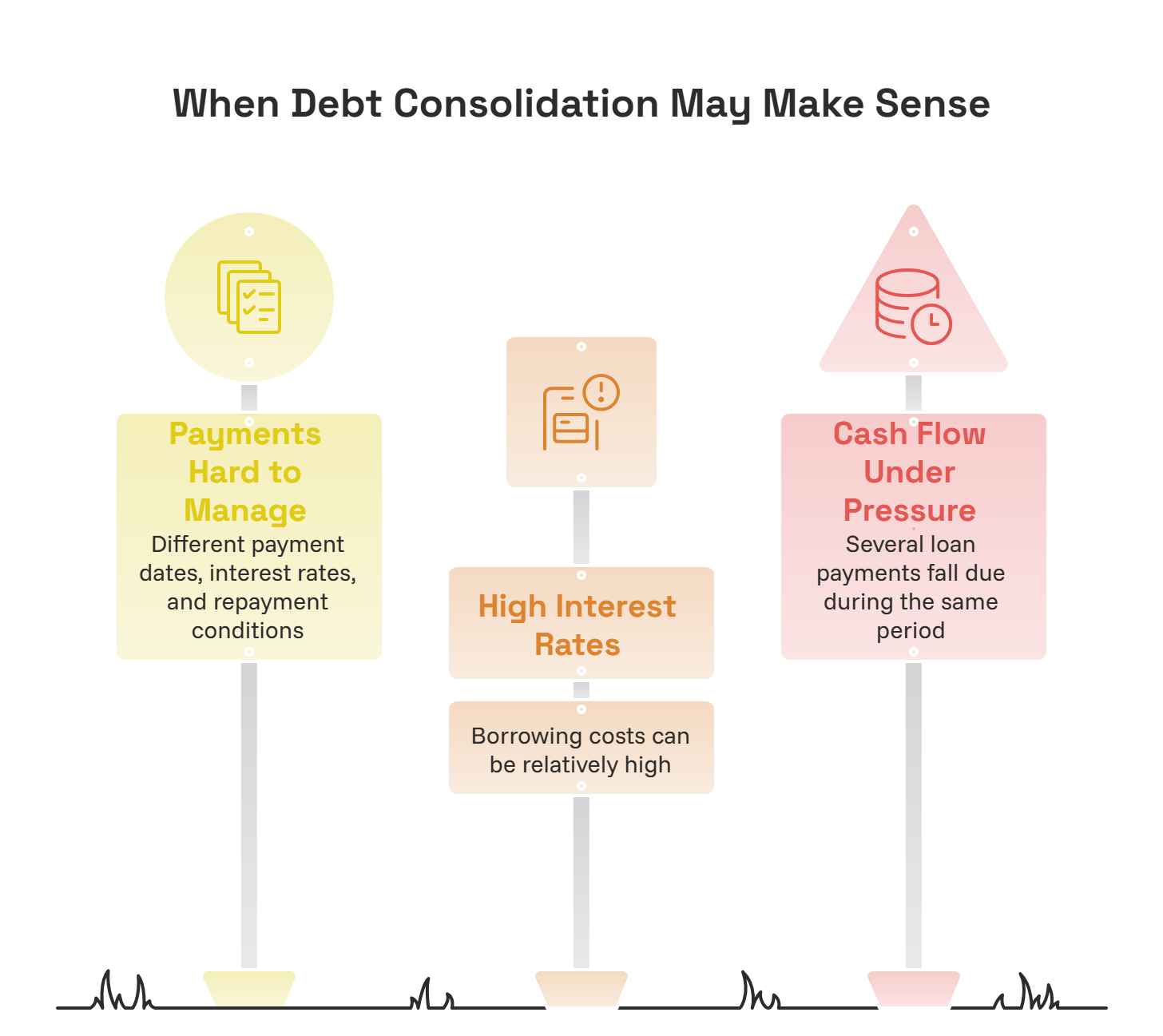
1. When Multiple Loan Payments Become Difficult to Manage
Businesses that have borrowed from several lenders may face different payment dates, interest rates, and repayment conditions.
Keeping track of these obligations requires time and careful financial planning. Missing even one payment can result in late fees and potentially damage the business’s credit profile.
Consolidating eligible debts into one loan can simplify payment management and make monthly budgeting easier.
2. When Existing Loans Have High Interest Rates
Some businesses rely on short-term financing or credit cards to manage temporary cash shortages. Although these options provide quick access to funds, their borrowing costs can be relatively high.
If a business qualifies for a consolidation loan with a lower effective interest rate, refinancing existing obligations may reduce the cost of borrowing.
For instance, replacing a high-interest balance with a lower-rate loan could create meaningful savings. Business owners should compare the annual percentage rate (APR), origination fees, prepayment charges, and total repayment amount before making a decision.
3. When Monthly Cash Flow Is Under Pressure
Cash flow problems do not always mean a business is unprofitable. A company may generate consistent revenue but struggle because several loan payments fall due during the same period.
Consolidation may help by spreading repayments over a longer period. This can leave more money available for payroll, inventory, rent, and other operating expenses.
However, owners should ensure that the revised repayment schedule matches the company’s expected revenue cycle.
4. When the Business Needs More Predictable Repayment Terms
Businesses with variable interest rates or frequently changing payment obligations may find it difficult to forecast future expenses.
A consolidation loan with a fixed interest rate and predictable monthly installments can make financial planning easier. This is particularly useful for businesses that want greater control over their operating budgets.
What Factors Should You Evaluate Before Combining Business Loans?
Before applying for new financing, business owners should review the following factors.
1. Compare the Total Cost of Existing Debt
Start by calculating the outstanding balance, interest rate, remaining repayment period, and additional charges for every existing loan.
Then compare these figures with the proposed consolidation loan.
For example, consider a business replacing $70,000 in existing debt with a five-year loan at an illustrative 10% annual interest rate. Assuming monthly amortization and no additional fees, the monthly payment would be approximately $1,487, with total payments of roughly $89,220 over five years.
The business should compare this amount against the remaining cost of its current loans. A lower monthly installment may improve short-term cash flow, but the overall financial benefit depends on the total repayment amount.
2. Review Creditworthiness and Business Financials
Lenders generally evaluate business revenue, cash flow, credit history, existing liabilities, and repayment capacity.
A business with consistent revenue and a manageable debt-to-income position may have more financing choices than one with irregular income or recent payment defaults.
Many commercial lenders also review debt service coverage ratio (DSCR). This measures whether the company’s operating income is sufficient to cover its debt obligations. A DSCR of 1.25, for example, means the business generates $1.25 in available income for every $1 of debt service. Actual lender requirements vary.
3. Check Prepayment Penalties and Additional Fees
Some existing loans include early repayment charges. A new lender may also charge origination, underwriting, or closing fees.
These expenses can reduce or eliminate the savings expected from consolidation. Always request a complete payoff statement and written loan estimate before accepting an offer.
4. Choose the Right Financing Structure
Not every business needs the same financing structure. Companies with substantial eligible receivables or inventory may explore asset based lending to access working capital using business assets as collateral.
However, asset-based lending is a separate financing solution and does not automatically consolidate or replace existing business debts. It can provide additional liquidity to support ongoing operations.
Other businesses may qualify for conventional term loans, business lines of credit, or refinancing arrangements. The right option depends on available collateral, revenue stability, outstanding debt, and the intended repayment period.
What Are the Practical Steps to Consolidate Business Debt?
A structured approach can help business owners avoid replacing manageable debt with a more expensive obligation.
Step 1: Prepare a Complete Debt Summary
List every outstanding loan, credit card, and financing agreement. Include the remaining balance, interest rate, monthly payment, maturity date, and any early repayment charges.
This provides a clear picture of the company’s total financial commitments.
Step 2: Explore Available Refinancing Options
Businesses that regularly deal with delayed customer payments can also consider receivables financing companies as an alternative source of working capital. These providers offer financing against eligible unpaid invoices, helping businesses access funds without waiting for customers to complete their payment cycles.
Do not select a lender based only on advertised rates. The actual offer may depend on the company’s financial profile.
Step 3: Evaluate Debt Restructuring Alternatives
Sometimes, taking out another loan is not necessary. Existing lenders may agree to modify repayment schedules, extend loan maturity, or adjust payment arrangements.
This type of debt restructuring may be worth exploring when a business is experiencing temporary financial difficulties and needs additional time to meet its obligations.
Step 4: Establish Realistic Debt Repayment Plans
Before accepting new financing, calculate how much the business can comfortably afford each month.
A practical repayment schedule should account for seasonal revenue changes, operating expenses, unexpected costs, and future investment requirements.
Step 5: Avoid Accumulating New Debt
Once existing obligations have been consolidated, avoid using newly available credit to accumulate additional balances without a clear business purpose.
The objective should be to improve financial stability, not simply create room for more borrowing.
How Can Small Businesses Improve Their Debt Management Strategy?
Consolidation is only one part of maintaining financial stability. Business owners also need consistent financial practices to prevent debt from becoming difficult to manage again.
Understanding how to manage debt starts with monitoring cash flow, reviewing expenses, and maintaining a realistic operating budget.
Businesses can also consider invoice financing for small businesses when delayed customer payments create temporary working capital shortages. This allows eligible companies to access funds against outstanding invoices rather than waiting for customers to pay.
Businesses looking to expand or manage short-term cash flow gaps may explore small business loans in USA to understand the financing options available. Comparing loan terms and repayment requirements can help owners choose funding that fits their business needs.
Conclusion
Managing multiple business loans can put pressure on cash flow and make financial planning more complicated. Business Debt Consolidation can simplify repayment when the new financing offers better terms and manageable costs. However, it is important to compare interest rates, fees, repayment periods, and existing loan obligations before making a decision.
Debt consolidation is not the only way to address working capital challenges. Depending on their financial position, businesses may also explore asset-based lending or receivables financing to access funds for daily operations and growth.
Frequently Asked Questions
1. Is Business Debt Consolidation a Good Idea for Small Businesses?
It can be beneficial when a business has multiple high-interest obligations and qualifies for financing with better overall terms. Consolidation may simplify payments and improve monthly cash flow. However, owners should compare total interest, fees, and repayment periods before proceeding to ensure that the new loan genuinely improves their financial position.
2. What Is the Best Way to Consolidate Business Debt?
The best approach is to compare the best business debt consolidation loans based on interest rates, repayment terms, fees, and eligibility requirements. Choose a loan that reduces repayment pressure without significantly increasing the total borrowing cost. Before applying, calculate your outstanding balances and check whether the new financing offers better terms than your existing loans.
3. Does Consolidating Business Debt Affect Business Credit?
Applying for new financing may result in a hard credit inquiry, depending on the lender. Paying off existing accounts and maintaining consistent payments on the new loan can support a healthier credit profile over time. However, the impact depends on the company’s credit history, account reporting, and overall debt management.
4. At What Point Should I Consider Debt Consolidation?
Consider debt consolidation when managing multiple loan payments becomes difficult, high interest rates reduce available cash flow, or repayment deadlines affect daily operations. If your business has stable revenue but struggles with existing debt obligations, exploring refinancing options may help simplify payments and create a more manageable repayment structure.
5. Can a Small Business Consolidate Debt With Poor Credit?
It may be possible, but the available financing options could be limited. Lenders may consider business revenue, cash flow, collateral, outstanding liabilities, and recent repayment history. Some businesses may also explore secured financing or negotiate revised terms with existing lenders instead of taking on another high-cost loan.